Scaling Robots? The Real Bottleneck Is the Human Workforce
As physical AI deployments grow from pilots to hundreds of sites, workforce design—not autonomy—may determine success, a new analysis argues.
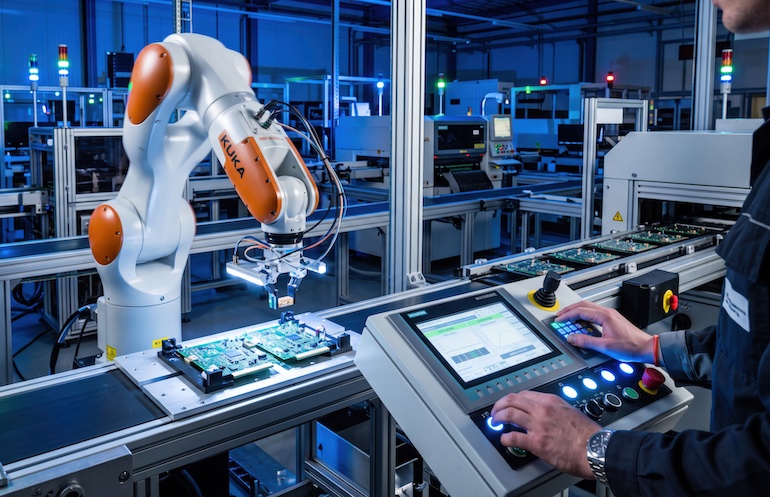
As robotics programs move from small pilots to sprawling, multi-site rollouts, a recurring theme is emerging: the robot is rarely what breaks the system. According to an op-ed published by The Robot Report and written by Christopher Bower, co-founder, chief revenue officer, and president of workforce platform HireArt, the real constraint is the human workforce required to operate, maintain, and adapt these machines in unpredictable real-world settings.
Most robotics deployments start small — five or ten units in a controlled environment, supported by engineers who are directly in the loop and highly trained operators who can resolve issues quickly. That tight coordination works well at a small scale, the piece notes, but it starts to strain once operations expand to dozens of sites across multiple shifts and inconsistent physical conditions. At that point, according to the article, robotics deployment stops resembling a product launch and starts behaving more like a distributed operations business.
Lessons from the evolution of AI labor
The article draws a parallel to how labor supporting AI systems has evolved over the past decade. Early computer vision projects relied on simple, task-based data labeling that could be spread across large, loosely coordinated crowds. As large language models took over, the nature of the work shifted toward judgment, nuance, and quality control — pushing teams away from crowd-based gig work and toward smaller, more structured groups with clear accountability.
Physical AI, the piece argues, is now undergoing a similar shift, but with higher stakes: when intelligence is embodied in machines running in warehouses, hospitals, factories, or public spaces, "quality" translates directly into uptime, safety, hardware integrity, and customer experience. Purely task-based or gig-style labor models, the article contends, tend to struggle in these environments, which demand consistent shift coverage, safety training, site-specific protocols, and clear escalation procedures.
A hybrid workforce model emerges
According to the op-ed, this gap is pushing many organizations toward hybrid workforce structures: a stable core of trained, hourly W-2 operators and technicians responsible for baseline execution, adherence to standard operating procedures, and escalation handling, surrounded by a more flexible layer of surge staff for pilots, new site launches, and specialized projects. While exact ratios vary by company, the article says a common pattern is roughly an even split between fixed and variable capacity, which is adjusted as systems mature and incident rates stabilize.
New job categories are also appearing that don't fit neatly into traditional roles — robot operators, field technicians, teleoperators, QA validators, and data capture specialists, who sit between engineering and operations. Their responsibilities go beyond simply running equipment: they interpret edge cases, document failures, and feed real-world observations back into engineering teams.
The article emphasizes that incentive design matters as much as team structure. Speed-focused metrics that were common in earlier forms of digital labor can "actively degrade performance in physical environments," the piece states. Instead, more teams are prioritizing procedure adherence, documentation quality, escalation accuracy, and safe behavior under uncertain conditions.
The overall takeaway from the op-ed, as reported by The Robot Report, is that scaling robotics is as much an organizational challenge as a technical one — and that the next phase of growth in the sector will hinge on whether companies can scale human judgment as reliably as they scale machine autonomy, across sites, shifts, and unpredictable field conditions.
HireArt, the company Bower co-founded, is a New York-based contract-for-hire platform that says its tool lets businesses build and manage a modern contract workforce through a single self-serve interface, covering employer-of-record services, on-demand sourcing, vendor management, and freelancer management. Bower has previously worked at HumanEdge, Tandym Group, and Access Confidential, and volunteers as a career coach at the New York Public Library.
talk to a robot
Wrong facts, cryptic artwork, missed news — pick the robot in charge and tell it directly. Litmus verifies the facts; what lands gets a thank-you engraved here.